At a glance
The project began with a practical research question: how can large, high-dimensional climate datasets be analyzed and explored without forcing every user to operate specialist scientific software?
My Ph.D. work connected two systems problems. The statistical side used spherical harmonics, numerical methods, and distributed Spark computation to derive and interpolate global climate fields. The delivery side used a database, web server, JavaScript, and WebGL to make large climate datasets interactive in a browser.
Evolution
Statistical research
The research required stable numerical implementations, distributed processing, and a way to reason
about global fields on a sphere. It became the foundation for the open-source mrsharky repository
and two publications.
Original JavaScript visualization
I built https://climate.mrsharky.com as an early browser-based interface for exploring the research outputs. It demonstrated that substantial visualization work could move into the browser while the server focused on preparing and delivering the right data.
4DVD
The next generation was an Angular application documented in my dissertation. It joined database storage, server-side delivery, JavaScript, and WebGL into a more complete system for visualizing large reanalysis datasets. It is still hosted at SDSU at https://4dvd.sdsu.edu
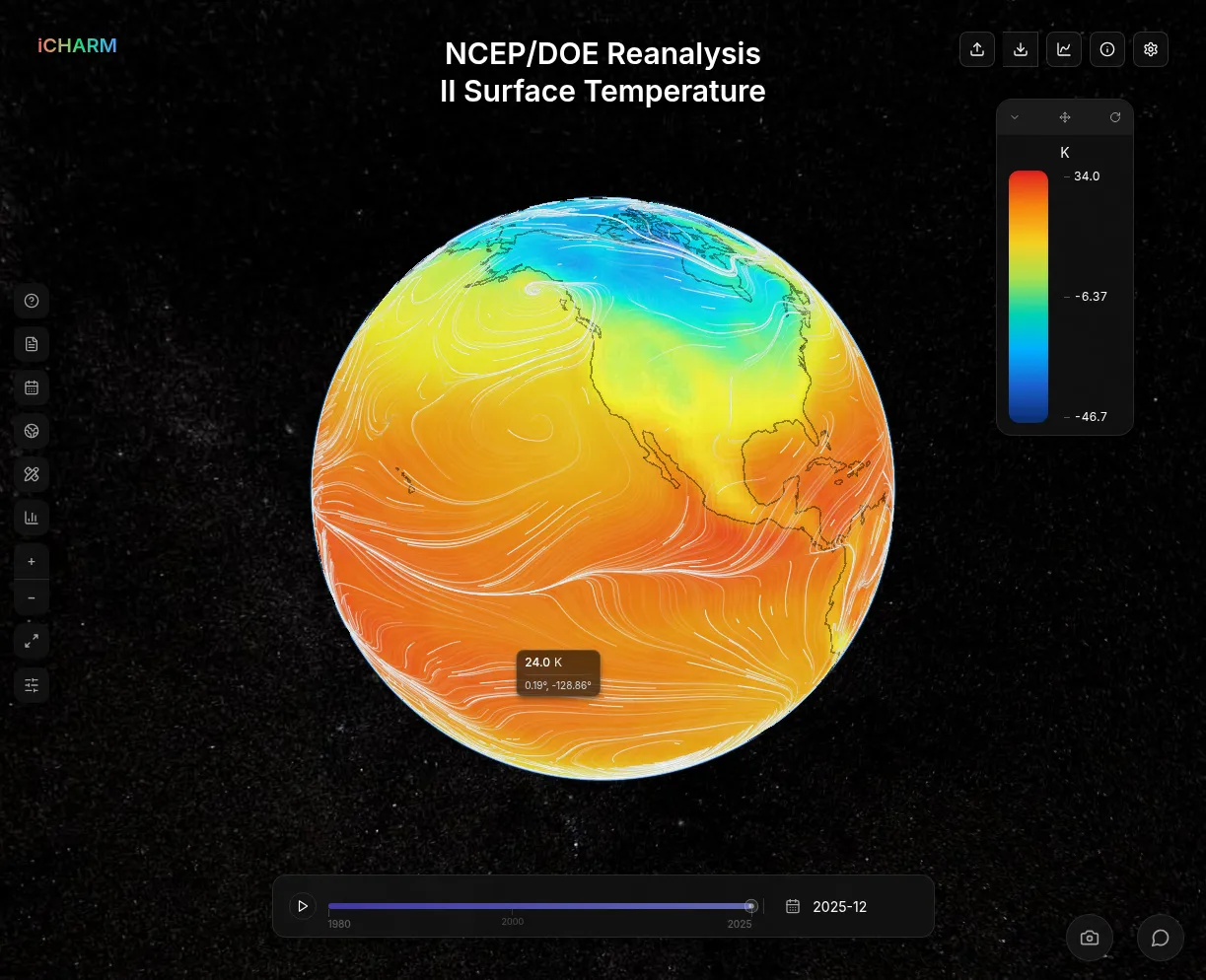
iCHARM
iCHARM continues that lineage as an evolving institutional platform. It reuses substantial logic from 4DVD and is expanding beyond gridded climate datasets into station data, shapefiles, and additional scientific formats. My current work focuses on backend behavior, data parsing, architecture, cleanup, and student mentorship.
Technical decisions
- Explain the domain problem before introducing the mathematics.
- Move interactive visualization into the browser while keeping data delivery bounded and reproducible.
- Use distributed computation when the numerical workload exceeds a single machine.
- Treat scientific file formats and metadata as product concerns rather than incidental preprocessing details.
Results and lessons
The most important result is continuity: research code became a working web system, that system became a dissertation artifact, and its logic continues to support a platform maintained and extended by collaborators and students.